

Planning Commission Oct 16, 2025
The Planning Commission is voting to approve zoning on Oct 21, 2025 in a Special Meeting.
In today’s issue, we summarize procedural issues on the final draft of the zoning. Following the law on public notice, we believe the city is still required to have a 15 day notice period on the final draft of the zoning before it is passed into law by the City Council. The city may disagree. We are unsure what exact procedures they will follow at the City Council, given the election and notice period. Several items were changed in the Oct 16th meeting, so it is important to read the most recent draft after the PC Special meeting on Oct 21st. And pay attention to the City’s website.
The next City Council meeting is on Monday, October 20th. (Agenda)
Absentee Voting
For those voting early or absentee, please be sure you now have your ballot. Some changes in state law may require you to request a ballot, which was not needed in the past for those who regularly vote absentee. We have also been told, but not confirmed, that some people with a legitimate right to vote were removed from the registry. These errors are easy to correct before Oct 31st. Bottom line, if you do not have your absentee ballot by now, contact Nick Whitaker (231) 526-2104 cityclerk@cityofharborsprings.com. You can also go to City Hall to request a ballot in person and typically vote at the same time. If in doubt, Nick is the authority, not We Love Harbor Springs. You can also go to the Michigan State site and validate your registry and manage the process: Michigan Voter Information Center.
Please do so now. It is not a big election, but good governance is consequential in small towns.
The Oct 16, 2025 Planning Commission Meeting
The Planning Commission meeting on October 16, 2025, resulted in several substantive updates to the draft zoning ordinance. Based on the discussion and subsequent actions, the updates were not minimal and were considered material enough to warrant working the weekend on redrafting. A dedicated review and approval session will be held on Tuesday, Oct 21, before moving the document forward.
We do not believe the city has met the statutory intent of the 15-day notice on legislation. Given the sequence of events, it appears the City Council will be required to have a 15-day period of public review and proper meeting notification per state law before a final adoption of the proposed zoning. If they do not, any future zoning action can be challenged.
Updates to the Zoning Ordinance on October 16, 2025
The Planning Commission focused on three main open issues during the public hearing: co-living, planned development (PD), and open space preservation. The resulting direction involved significant modifications to the Planned Development article, which had been a major source of public concern.
Key substantive changes agreed upon in the October 16th meeting appear to include:
Planned Development (PD) Restrictions: The Commission appears to have adopted several changes for Planned Developments from the September draft. Acerage limits appear to have been removed. The City’s planning consultant advocated for what we would call a pro-development-friendly approach. He did not adopt our objective measures. It was difficult for the audience to rebut his points. While the PC has advocated for fewer zoning districts, planned development allows for multiple new micro districts.
Co-Living/Family Definition: The Commission discussed modifying the definition of “family” to accommodate more people living together and eliminating the specific definition and restrictions for “co-living”. They discussed several aspects of housing for employees.
Open Space Preservation: The Planning Commission supported renaming “cluster housing” to “open space preservation” and aligning it with state statute MCL 125.3506. This tool allows clustering of housing units on large properties to preserve green space without increasing density.
You really must read the draft to understand the nuances of the changes. With so many changes, it is nearly impossible to get all the details correct. But once passed, those details may have a substantial impact on your property rights.
We advocated for incremental changes from the start, but the City pushed to redraft every element of the code against the clear intent of the voters and property owners. Given the scope of change, the process must be accountable to the rights of each property owner before rights are changed.
Necessity of Further Public Notice
The meeting and discussion lasted more than two hours and 35 minutes. The shift in the requirements and restrictions for Planned Developments represents substantial changes since the last draft.
A Commissioner stated that a final product reflecting the material changes needed to be seen before a vote could take place, adhering to procedural fairness that normally applies when major legislative changes are adopted.
The Planning Commission chose to address this procedural requirement not by holding a new public hearing with 15 days notice, but by scheduling a Special Meeting five days later on October 21, 2025, for the explicit purpose of reviewing and approving the revised draft zoning ordinance. This course of action ensured the Commissioners themselves were comfortable with the final language before recommending it to the City Council, without extending the formal statutory public notice period for the benefit of the community.
The City Attorney present at the meeting suggested that, although a public hearing was likely not required for the revised zoning draft, holding one would be prudent due to the contentious nature of the issue. The PC ultimately voted to schedule a special meeting on October 21, 2025, to vote on the final draft for the City Council. It appears that the special meeting will not include public comment.
Why the 15-Day Notice Matters
When local government takes up a major decision, like rewriting the zoning code or changing a land-use rule, Michigan law requires at least 15 days’ public notice before the hearing. That period isn’t just bureaucratic formality. It’s a constitutional safeguard designed to protect citizens from the government acting faster than the public can respond.
The 15-day window gives everyone a fair chance to see exactly what’s on the table, study the proposal, and decide whether to speak up. It ensures the process is transparent and participatory, not something decided in a back room or rushed through on a technicality. In land-use law, this notice period is treated seriously. Michigan courts have consistently ruled that if the notice is unclear, incomplete, or materially different from what’s eventually voted on, the decision can be invalidated. Judges look for whether the public had a real, practical opportunity to understand what was being proposed in the final copy and how it might affect them. If the proposal changes significantly after the hearing notice, the law expects the city to re-notice and hold another hearing. The courts’ logic is simple: you can’t engage the public on one version of a law and then adopt another.
This process isn’t meant to slow progress; it’s meant to build legitimacy. The 15-day period is when a community can come together, review the actual documents, and have clear expectations about what’s being decided. During that time, residents should be able to find a single, definitive draft, understand that the hearing is for a vote on the final ordinance, and see that no further last-minute edits will slip in.
In that sense, the notice period isn’t just about compliance, it’s about trust. It’s how a small town like Harbor Springs keeps decision-making grounded in the people who live here. The law gives us those 15 days not to delay, but to ensure that when we move forward, we do so together, informed and aligned.
The 15-day notice for this meeting should have been on the final draft. Discussion and changes should have been minimal. The notice must also be posted in the newspaper and places like the IGA.
Citizen Feedback Highlights Need for Clearer Zoning Document Access
While it is now clear that the planning commission chair intended to approve the zoning in the October 16th meeting, nowhere in the public notice or on the city’s website did they indicate that the purpose of the public hearing included calling the zoning final and voting on its approval.
During the discussions, citizen advocate Karin Offield noted the difficulty that members of the public experienced in locating the draft ordinance, even after it was announced as being available online.
City Assessor and Zoning Administrator Jeff Grimm countered this concern by detailing the existing distribution methods and arguing that the documents were easily accessible. Grimm pointed out the multiple channels used for public notice, including publication in the paper 15 days prior, posting on the municipal website, and displaying notices prominently at City Hall.
When challenged on the difficulty some citizens faced knowing which draft of the zoning to review, Grimm described the steps necessary to retrieve the digital draft:
“I think it’s extremely easy to find right on our homepage on the city website we have news posts and one of those news articles is the update of the zoning code and on that there is a link directly to the website that has all of the information about the zoning code and the process we’ve been through with a link to download.”
This exchange highlighted a procedural conflict: while staff members like Grimm, who deal with this all day, are confident that the documents were easy to find via the official homepage and news articles, public feedback suggested that the documents were not.
The news post Grim referenced was from August 27th about a public meeting on Sept 18th, linking to a new website none of us have seen before. The news post was adjacent to the latest update about the city being closed on September 1st. The meeting Offield was asking about was for Oct 16th. Are you confused yet? So are we.
It would be easy for someone thinking about the October 16th meeting to find the August 27th notice irrelevant. Perhaps even an error. Here is the notice, with no reference at all to the October 16th meeting:
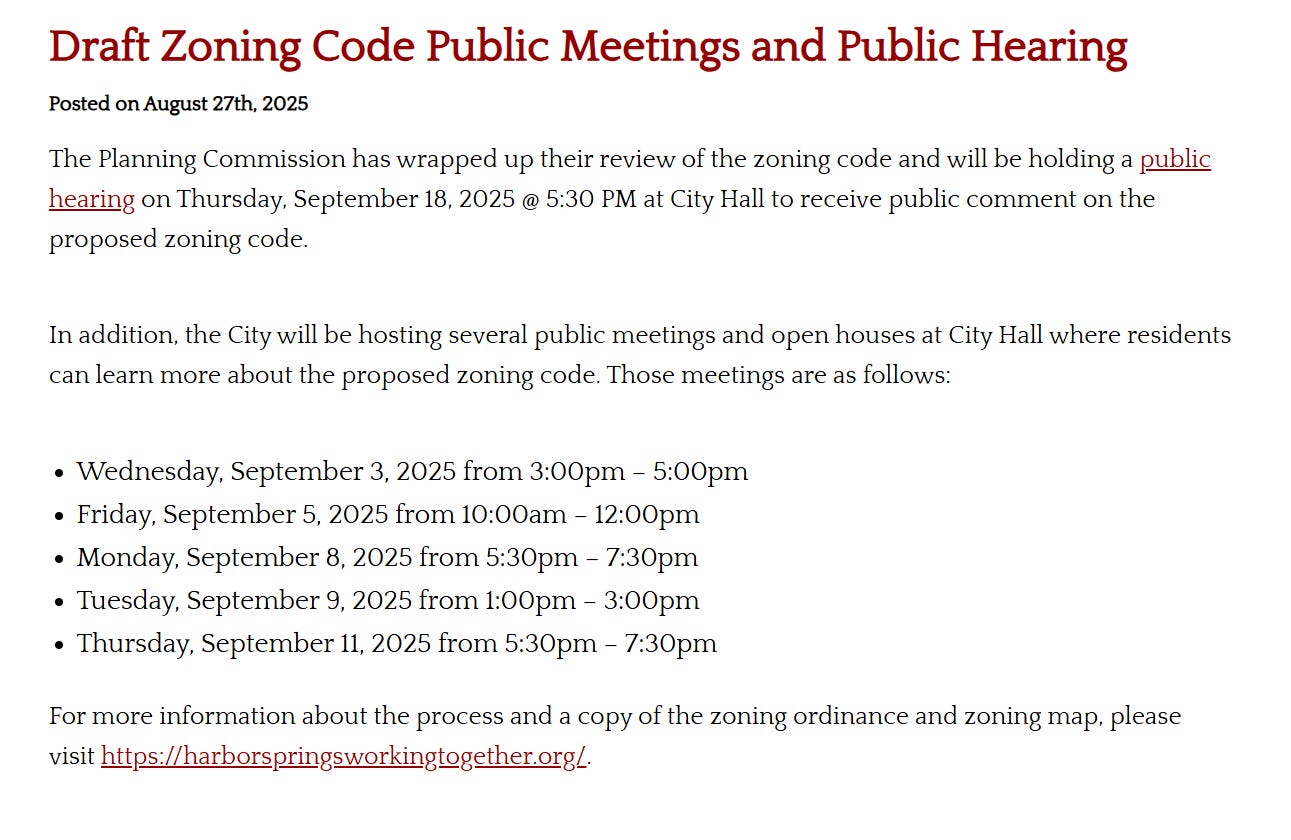
Specifically, Offield recommended making the zoning draft document a clear bullet point on the Planning Commission’s dedicated webpage, where it has always been, with a clear statement of the reason for the meeting. Drafts should have a clear date, and a copy of the redline and blackline so people can see the differences. Offield argued that relying on news articles for navigation was confusing for many residents who visit the official city Planning Commission documents page. With the many drafts available, it is difficult for people to find “The Copy” for review.
This discussion underscored the principle that accessibility should be judged not solely by staff’s adherence to arcane notification protocols (i.e. the newspaper), but by the ease of use and feedback provided by the citizens themselves.
The necessity for user-friendliness and clarity has been a driving force throughout the zoning rewrite process. Some of the disagreement stems from frustration with obtaining relevant information. We would argue that the next City Council should set a goal to ensure the city can reach nearly 100% of citizens and property owners via text or email. It is not against the law to over-communicate. Cities are actually even allowed to violate many spam laws.
We have repeatedly raised the need for better notifications. We have spent a lot of time clarifying information for angry citizens. It took us months to have the City Council grudgingly agree to improve the AV and Zoom for meetings. The City’s procedures lag conventional practices and make it difficult to focus on the key issues. Citizens need to voice their concerns and help the City understand opportunities to improve.
I am livid that, yet again, this Planning Commission is powering through to pass zoning that has been objected to by countless citizens. Does the November 2024 rejection of 439 not mean a dang thing??? They have NO respect for the electorate and, in my opinion, legal options should be explored.
Not all actions by elected officials or by the bureaucrats who do the day to day work of implementing governmental policy are consciously executed with an attempt to keep the citizenry in the dark (although it is not unheard of for Government at all levels to at times be consciously opaque rather than transparent.) Often, opaque governmental activity is due to a significantly different culture in which the elected leaders and the bureaucracies work from the culture in which ordinary citizens live and work. When was the last time, as an example, that you tried navigating any governmental web site and found it easy, or tried contacting a governmental agency and found it easy?