

Planned Development to Preserve & Protect
There is no eraser once zoning is adopted
Brief
Interim City Manager/ Chief Kyle is proposing to move winter City Council meetings to 6PM. Please keep an eye on the schedule for meeting time changes.
City Council will meet on Monday, January 5th, at 7 PM City Council public hearing on Zoning. The meeting will begin at 6 PM for other agenda matters.
Here is the agenda and link to Zoom Meeting, or on You Tube
The next scheduled Planning Commission meeting is on Thursday, January 15th, at 5:30 pm. Check here for the agenda when available: Zoom Meeting, You Tube
Remember, the Planning Commission only makes a recommendation on zoning to the City Council. Only the City Council can decide on zoning updates.
Planned Development (PD/PUD) - Strong enough for Harbor Springs?
In a meeting in early May 2025, when the Planning Commissioners discussed standards and property rights, Mark Rondel spoke regarding a variance request for a garage, noting that while the proposal met technical criteria, neighbor objections influenced the Commission. He argued that the current code is “arbitrary and ambiguous” and that “subjective decisions to satisfy multiple parties” make fairness difficult. He warned against allowing “neighborhood outcry” (subjective) to override zoning rights (objective). The entire summer was mostly “Straw Man” discussions like these, which allowed the Planning Commissioners to learn about the zoning pieces, without making any hard decisions.
Much later, at another meeting in October, 5 months later, Planned Development was again discussed, and Carter Williams presented a draft PD ordinance written by city planning consultant Lynee Wells, explicitly stating its purpose was to insert “objective measures” because the current draft lacked them.
That led to a proposal by Beckett & Raeder to meet in a working group. When the working group wanted the meeting to be public, it was cancelled by the City.
At the October meeting, Andrew Von Maur (licensed architect & land planner) supported this version of Planned Development, stating that without objective measures, the Planning Commission relies on “subjective judgment,” which makes applications “acrimonious” and susceptible to political pressure. Phillip Allore (U of M Graduate, City of Harbor Springs graduate, architect) noted that the new draft did include some objective standards.
In November, in another Planning Commission meeting, when the Lynee Wells’ critique was discussed, two opposing sides emerged...one emphasizing that the code is a “living document” that could be amended later. Another Commissioner expressed concern about ignoring the controversial items now (the subjective nature of the PDs and the Administrative Review Committee), but was outvoted. The discussion further focused on whether to accept the Lynee Wells’ memo outlining necessary PD and other zoning changes to enhance objectivity, rather than debating the philosophy of the language itself.
We will attempt to explain: a PD is an optional tool. It allows a developer to deviate from strict zoning rules (such as uses, setbacks or lot sizes) only if they provide a specific benefit to the community and meet rigorous qualification standards. It is not a right; it is a negotiated agreement. Essentially, if a majority of the Planning Commission and City Council agree to a design, it allows a developer to build to the #439 zoning.
Based on the provided sources, specifically the 2005 Zoning Code, Lynee Wells’ December 2025 Memorandum, Draft PD Proposal, and Planning Commission transcript,here are 20 examples distinguishing between subjective terminology (open to interpretation/litigation) and objective terminology (measurable/defensible).
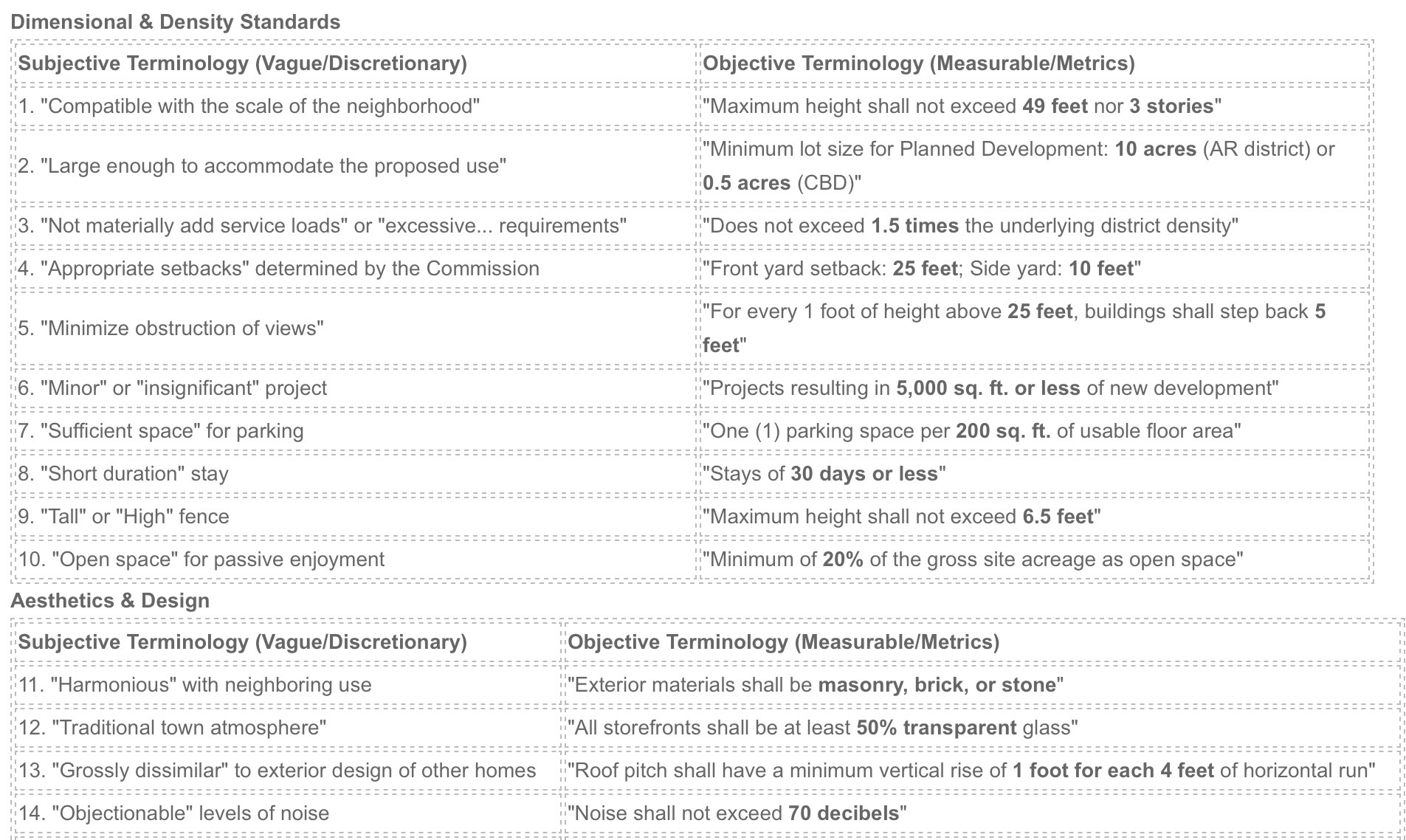
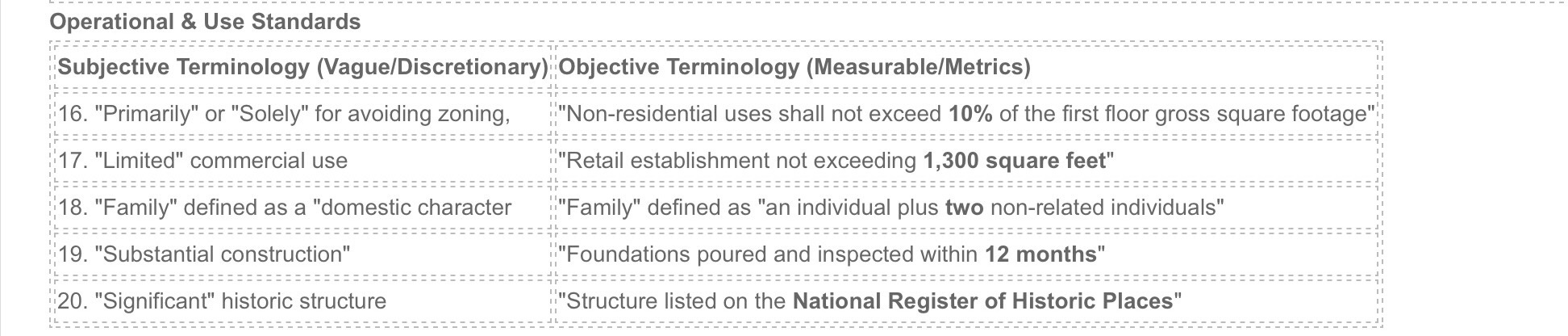
Conclusion:
Chair Bill Mulder claims that the Planning Commissioners’ Planned Development (PD) standards are the “toughest in the business” can be refuted by pointing to the prevalence of subjective language over objective metrics, the removal of “gatekeeper” requirements found in previous codes, and the specific critiques leveled by city planner Lynee Wells.
1. The primary refutation is that the draft code relies on “feelings” (subjective) rather than “math” (objective).
The Critique: Lynee Wells, a city planning consultant hired by We Love Harbor Springs, explicitly challenged the draft on Zoom and in Memos in Oct. Nov. & December 2025, stating, “the PD process remains subjective, with very little objective standards.”
Specific Examples: The draft code relies on discretionary terms such as whether a project is “desirable,” “harmonious,” or “compatible.
The Findings: A “tough” code uses objective standards (e.g., “must be set back 50 feet”) that cannot be argued in court. A subjective code (e.g., “must be harmonious”) allows a Planning Commission to approve a project based on opinion. Wells warns that “subjectivity in review and approval opens the City to costly legal challenges” because developers can claim a denial was arbitrary if the rules weren’t clear.
2. The “Faulty” Density Cap
The Commissioners might argue the code is “tough” because it limits density to 1.5 times the underlying district. However, this standard is refuted by the lack of baseline density in commercial zones.
The Critique: Wells points out this standard is “faulty because there are no density standards in the commercial, office or CBD districts as there is no minimum lot area.”
The Findings: If the underlying district has no density limit (no minimum lot area), then “1.5 times” that limit is mathematically meaningless. A developer could propose a massive project in a commercial zone, and the “tough” density cap would not actually restrict them
3. Removal of “Gatekeeper” Standards (The 10-Acre Rule)
You can refute the “toughest” claim by comparing the proposal to the city’s own 2005 Zoning Code.
The Old Standard (Tougher): The 2005 zoning code required a minimum of 10 acres to apply for a PUD outside the CBD. This acted as a “gatekeeper,” ensuring PUDs were only used for large, master-planned projects.
The Proposed Standard (Weaker): The draft discussed in 2025 removed the minimum acreage requirement entirely, potentially allowing PUDs on small, single lots.
The Findings: By removing the acreage minimum, the new proposed 10.21.25 code actually made it easier, not tougher, for developers to use the PD process to bypass standard zoning on small lots. Will it take community intervention (the “Wells Memo”) to force the reintroduction of the 10-acre requirement into the draft?
4. Comparison to “By-Right” Plans
A “tough” standard would force a developer to prove their project is better than what is allowed by standard zoning.
The Critique: Carter Williams and Lynee Wells argued for a mandatory “test plan” or “comparison table”. This would force a developer to draw a plan showing what theycould build under normal rules versus what they want to build.
The Commission’s Resistance: Planning Consultant John Iacoangeli argued against this requirement, stating it was “costly” for developers to spend money drawing a base plan when the ordinance already allowed density increases.
The Findings: If the standards were truly the “toughest,” the Commission would mandate this comparison to prove the public benefit. By resisting it to save developers money they prioritized developer efficiency over rigorous objective proof of benefit.
5. Staff’s Defense vs. Reality
The Planning Consultant defended the new draft by arguing it was tougher than the existing PD overlay in the CBD.
The Defense: Harbor Springs hired City Planner Beckett & Raeder’s, John Iacoangeli stated that the existing (2005) PD ordinance was “a hell of a lot more flexible” than the draft because it allowed 49 feet in height, whereas the draft was more restrictive.
The Findings: While the draft might be tougher on height than the 2005 code, it was looser on eligibility (removing the 10-acre minimum). Furthermore, resident Mark Rondel pointed out that “zoning is a mechanism of exclusion” and that arbitrary standards (subjectivity) actually threaten property rights by allowing the Commission to pick winners and losers based on “neighborhood outcry” rather than law.
Summary for Readers Discussion
While the proposed draft may restrict building height more than the 2005 code, it is structurally weaker because it relies on subjective terms like ‘compatibility’ rather than objective metrics. As Lynee Wells noted, the ‘1.5x density’ cap is mathematically unenforceable in commercial districts with no base density. Furthermore, true ‘tough’ standards would mandate a 10-acre minimum to prevent spot-zoning, a standard that existed in 2005.
Instead of letting the Planning Commissions of the future approve projects based on feelings about “harmony,” this zoning proposal, suggested by Lynee Wells requires the project to meet measurable, objective criteria. This protects the city from lawsuits by developers who might claim a denial was “arbitrary’”. Objective standards are legally defensible and preserve the city’s resources from costly litigation.
The work that still needs to be done to the proposed zoning will ensure that even “creative” projects, with complicated and professional renderings of the projects remain consistent with the scale of the surrounding town of Harbor Springs. These tools that Lynee Wells is saying are NOT in the October 21, 2025 Code are safety locks that protect the town’s character immediately upon passage and ensure that any deviation from the code is a calculated trade-off for a community benefit, not just a developer’s preference.
Also, the Planned Developers projects must be consistent with the City’s Master Plan and Future Land Use Map. This is a mandatory standard, not just a suggestion. If you attended the summer of 2025 meetings you were able to view the progress two ways: those that had a Justification for Change: Consultants and staff frequently cited the Master Plan to justify density increases and zoning district consolidations (e.g., combining R1B and R1C. and those that stood up and spoke of the Argument Against Change: Residents frequently cited the Master Plan’s goals, the earlier surveys regarding “small-town character” and “preservation” to argue against those same changes.
Sending the code back is not anti-growth. These points were raised numerous times during the summer with no resolution. They need to be resolved. They expand property rights and are very difficult to reverse. It is pro-clarity, pro-fairness, and pro-community.
Harbor Springs deserves a PD ordinance that is a true exception, not a permanent loophole, an ordinance with further clarity for heights, clearly stated Admin Review by Committee and the elimination of mistakes.
Zoning is hard, but we are almost there!
Here is some more info that will help: an interesting wrap-up
The current effort to advance a comprehensive zoning reform through the Planning Commission and secure adoption by a City Council majority reflects both urgency and political calculation by its supporters. Whether this effort succeeds—or ultimately backfires—will depend not solely on the final vote count, but on how the process itself is perceived by the community it is meant to serve.
Harbor Springs voters have already weighed in once on this issue. That history matters. The coming weeks will test the boundary between legitimate governance and political opportunism, and will determine whether public trust can be preserved and understood. A zoning code adopted without full confidence, clarity, and community consensus risks undermining not only land-use outcomes, but the credibility of local decision-making itself.
Why Process Matters More Than Speed
Zoning ordinances are not temporary policy statements. Once adopted, they become permanent law, shaping development patterns, neighborhood character, infrastructure demands, and environmental outcomes for decades. Unlike many legislative actions, zoning codes are difficult to reverse, even when unintended consequences emerge.
Rushing adoption does not simply accelerate progress—it transfers long-term risk to the community. Ambiguities, discretionary standards, and unresolved provisions are not neutral. They create interpretive space that will be filled later through administrative decisions, developers, legal challenges, or project-by-project exceptions, often outside the public eye. In this context, speed should never be confused with effectiveness.
The Public Trust Imperative - Important to Consider
Public trust is not built through procedural compliance alone. It is built through transparency, deliberation, and the shared understanding that major decisions reflect broad and meaningful engagement.
The repeal of the prior zoning ordinance demonstrated that Harbor Springs residents are attentive, informed, and willing to act when they believe the process of asking City Council to delay their vote in May 2024 has failed them. That episode was not simply a policy rejection; it was a referendum on process. Proceeding now without fully addressing known concerns risks repeating the same mistake—only with higher stakes.
A perception that the outcome is being predetermined, or that remaining issues are being deferred “until later,” erodes confidence even among those who support reform in principle.
The Risk of Narrow Majorities and Lasting Law
Adopting a sweeping zoning overhaul by a slim margin carries inherent risk. Laws passed under such conditions may be legally valid, but they are politically fragile. They invite continued conflict, legal scrutiny, and future repeal efforts—none of which serve the city well.
Good zoning is not measured by how quickly it is passed, but by how well it endures. Endurance comes from clarity, fairness, and legitimacy. That legitimacy is strongest when a code is clearly finished, broadly understood, and widely supported.
A Choice with Long-Term Consequences
City Council now faces a consequential choice: whether to prioritize speed or stewardship.
Sending an unfinished zoning code back for targeted refinement is not obstruction. It is responsible governance. It acknowledges the permanence of the decision, respects the lessons of recent history, and affirms that Harbor Springs is committed not just to change, but to getting it right.
In land-use policy, there is no eraser. Once adopted, the code will shape the city long after the current council members have left office. That reality demands patience, care, and the courage to slow down when the stakes are this high. WLHS Research Team
What is the development north of Bluff Gardens on the south side of Lake street?